You May Not Have Seen a Doctor in Years. Did Anyone Tell You?
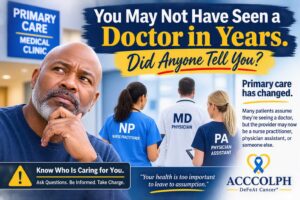
For many Americans, a surprising reality has quietly emerged: they may not have seen a medical doctor in years.
When patients schedule an appointment with a primary care office, many assume they will be seen by a physician. Instead, they are increasingly being seen by a nurse practitioner (NP) or physician assistant (PA). These professionals play important roles in healthcare, but many patients may not realize how dramatically the primary care landscape has changed. Over time, the shift has occurred so gradually that few people stopped to ask when it happened or whether patients were fully informed.
The Quiet Transformation
The rapid growth of NPs and PAs is not a matter of opinion. It is documented.
A 2023 Harvard Medical School and BMJ study found that the proportion of healthcare visits delivered by NPs and PAs increased from 14% in 2013 to 25.6% in 2019, meaning roughly one in four healthcare visits was provided by a non-physician clinician. [healio.com], [hms.harvard.edu], [bmj.com]
Among Medicare patients, more than 42% had at least one visit with an NP or PA, and approximately 10% received care only from an NP or PA during the study year. [medicaleconomics.com], [bmj.com]
For many Americans, this shift happened without a public conversation about what it means for patient care, provider choice, and healthcare costs.
Why Did This Happen?
One reason is a growing physician shortage.
The Association of American Medical Colleges (AAMC) projects the United States could face a shortage of up to 86,000 physicians by 2036, including a shortage of 20,200 to 40,400 primary care physicians. [aamc.org], [chiefhealt…cutive.com]
The Health Resources and Services Administration (HRSA) projects a shortage of more than 70,000 primary care physicians by 2038. [bhw.hrsa.gov]
Healthcare systems increasingly rely on NPs and PAs to fill those gaps.
Paying More, Getting Different Care?
Healthcare costs continue to rise, yet many patients find it harder than ever to schedule appointments with a physician.
The concern isn’t whether NPs and PAs are valuable. Many are exceptional providers.
The concern is transparency.
Patients deserve to know who is providing their care and understand the differences in education and training. Physicians complete medical school and residency training that typically spans more than a decade after college. NPs and PAs follow different educational pathways that are shorter and structured differently.
These are not identical credentials, and patients should be informed when healthcare systems change who is providing primary care.
The Generic vs. Brand Name Analogy
Imagine being prescribed a generic medication.
Many generic medications work extremely well and are therapeutically equivalent to brand-name drugs. Some are even manufactured in the same facilities.
But patients are told when they are receiving a generic rather than a brand-name medication.
In healthcare, many patients may not realize that their “doctor’s appointment” is no longer with a doctor.
Again, this is not a criticism of NPs or PAs. It is a question of informed choice.
A System Wide Shift
Federal workforce data show there were approximately:
- 340,319 primary care physicians in the United States in 2023.
- 374,970 nurse practitioners practicing in primary care in 2024.
- 29,433 physician assistants practicing in primary care in 2024. [bhw.hrsa.gov], [practiceseeker.com]
For the first time, the number of nurse practitioners working in primary care exceeds the number of primary care physicians. [bhw.hrsa.gov], [practiceseeker.com]
That is a remarkable transformation from the healthcare system many Americans grew up with.
The Question We Should Be Asking
The issue is not whether NPs and PAs belong in healthcare. They absolutely do.
The issue is whether patients understand that the traditional physician-centered primary care model has changed dramatically.
As healthcare costs continue to climb, patients have a right to ask:
- Am I seeing a physician?
- If not, who is providing my care?
- Why wasn’t this explained more clearly?
- Am I paying more while receiving less access to doctors?
These are reasonable questions.
The Bottom Line
America’s primary care system has undergone one of the biggest transformations in modern healthcare. Today, roughly one out of every four healthcare visits is provided by an NP or PA, physician shortages continue to grow, and many patients may not realize they have not seen a physician for routine care in years. [healio.com], [hms.harvard.edu], [aamc.org]
Patients deserve transparency, informed choice, and access to the level of care they expect.
The conversation should not be about physicians versus NPs or PAs.
The conversation should be about ensuring that patients know who is caring for them and why.